
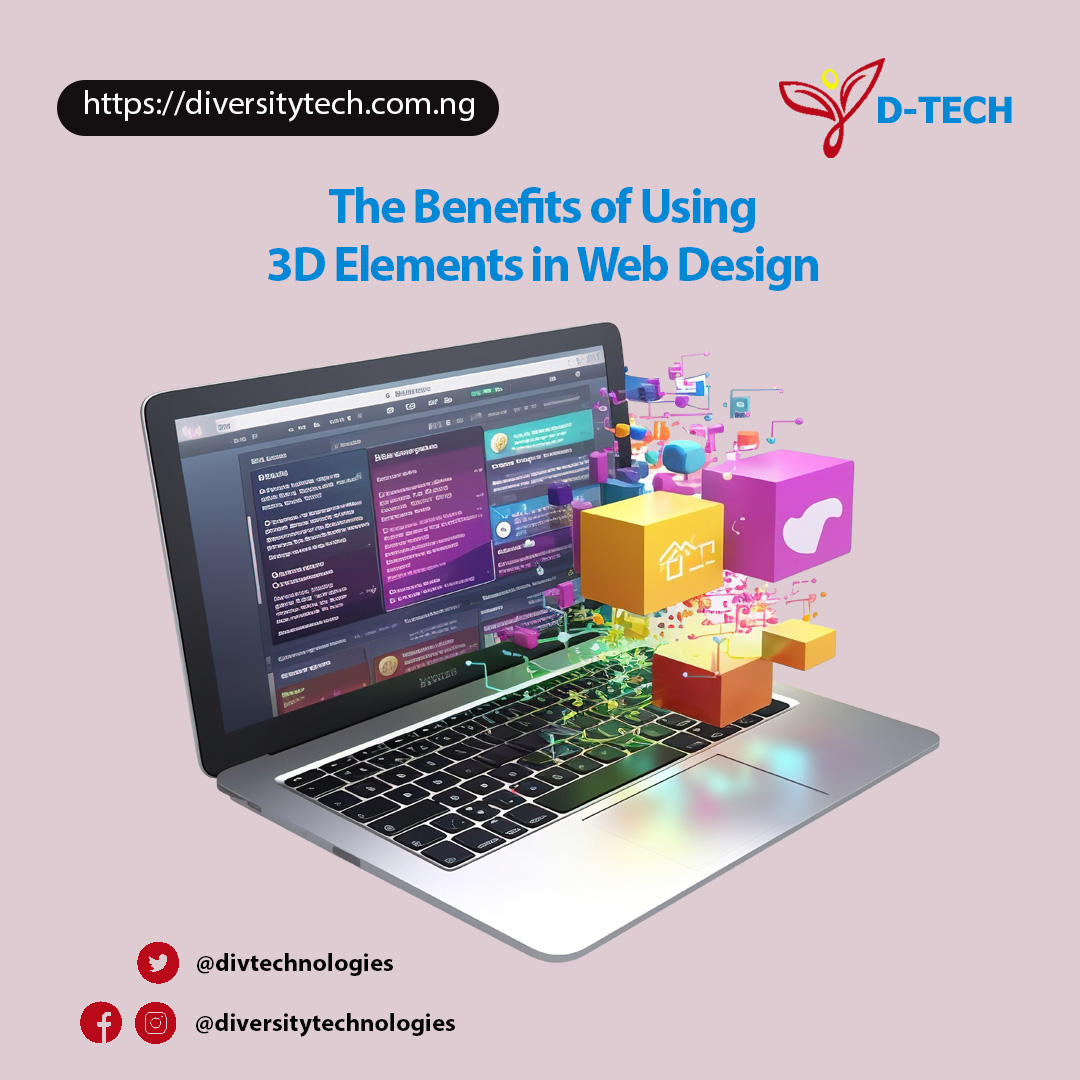
Web design continues to evolve as businesses look for better ways to capture attention and create memorable online experiences. While clean layouts, responsive design, animation, and video remain important, 3D elements in web design are becoming increasingly popular for businesses that want their websites to stand out.
From interactive product models to animated objects and immersive visual experiences, 3D technology can transform an ordinary website into something more engaging.
However, using 3D isn’t simply about making a website look impressive. When implemented strategically, 3D elements can support user experience, storytelling, product presentation, brand differentiation, and conversions.
At Diversity Technologies, we believe technology should serve a purpose. In this article, we’ll explore the benefits of using 3D elements in modern web design and how businesses can use them effectively.
What Are 3D Elements in Web Design?
3D web design involves incorporating three-dimensional graphics, models, animations, or interactive objects into a website.
Unlike traditional 2D graphics, 3D elements create the perception of depth, perspective, movement, and space.
Examples include:
- Interactive 3D product models
- 3D animations
- Rotating objects
- Interactive environments
- Three-dimensional illustrations
- 3D typography
- Animated backgrounds
- Virtual product demonstrations
- Interactive maps
- 3D visualizations
Modern web technologies make it possible to deliver these experiences directly through a browser without requiring users to install specialized software.
1. 3D Design Captures Attention
One of the biggest advantages of 3D web design is its ability to capture attention.
Internet users are exposed to thousands of websites, advertisements, videos, and social media posts every day. A website that looks and behaves differently can create an immediate impression.
A carefully designed 3D hero section, product visualization, or interactive element can encourage visitors to explore the page instead of immediately leaving.
However, the objective shouldn’t be to overwhelm visitors.
Use 3D to attract attention, then use clear content and calls-to-action to guide the visitor.
2. Creates a More Engaging User Experience
Traditional websites are largely passive. Users scroll through text and images.
Interactive 3D elements can make visitors active participants.
For example, an eCommerce website selling furniture could allow customers to:
- Rotate a product
- View it from different angles
- Zoom in
- Explore different finishes
- Interact with product features
This creates a more engaging experience and can help users understand a product before making a purchase.
3. Improves Product Visualization
3D is particularly useful for businesses that sell physical products.
Instead of showing customers several static images, a business can provide an interactive model that allows users to examine the product from different perspectives.
This can be useful for:
- Furniture companies
- Automobile businesses
- Property developers
- Interior designers
- Fashion brands
- Technology companies
- Manufacturers
- Architecture firms
For products where shape, dimensions, materials, or details matter, 3D visualization can provide valuable information.
4. Makes Complex Ideas Easier to Understand
Some businesses offer products or services that are difficult to explain using text alone.
3D visualization can simplify complex concepts.
For example, an engineering company could use a 3D model to demonstrate how a machine works.
An architectural company could provide an interactive model of a proposed building.
A technology company could visually demonstrate how its infrastructure works.
Instead of telling visitors how something works, you can show them.
5. Strengthens Brand Identity
Your website is an important part of your brand identity.
A distinctive 3D experience can help your business establish a unique visual identity and differentiate itself from competitors.
For technology companies, creative agencies, architecture firms, entertainment brands, and innovative startups, 3D design can communicate qualities such as:
- Innovation
- Creativity
- Technology
- Premium quality
- Forward thinking
The design should still reflect the company’s overall branding, including its colors, typography, tone, and messaging.
6. Supports Visual Storytelling
Good websites tell a story.
Instead of presenting visitors with a collection of disconnected pages, businesses can use visuals to guide users through an experience.
3D elements can help communicate:
Problem → Solution → Product → Benefits → Action
For example, a construction company could use 3D visualization to take visitors from a conceptual design to the completed development.
This can make complex information more understandable and memorable.
7. Can Increase User Interaction
Interactive elements encourage users to engage with a website.
A visitor might:
- Rotate a product
- Move through an environment
- Click different objects
- Explore an interactive diagram
- Change product configurations
- View animations
The more meaningful interaction a website provides, the more opportunities there are to communicate your message.
However, interaction should always have a purpose.
8. Helps Businesses Stand Out From Competitors
Many businesses still use relatively conventional website layouts.
A strategic 3D experience can provide differentiation.
Imagine searching for two companies offering similar products. One website presents static images and generic descriptions, while the other allows you to interact with detailed 3D product models.
The interactive experience may leave a stronger impression.
Good design gives your brand a competitive advantage.
9. Enhances E-Commerce Experiences
3D technology can be particularly valuable for eCommerce.
Customers cannot physically touch products when shopping online. This creates a challenge for businesses.
Interactive 3D models can help bridge some of that gap.
For example, an online furniture store could allow customers to inspect a chair from different angles before purchasing.
A fashion brand could use 3D visualization to display products in greater detail.
A car dealership could allow customers to explore vehicle features interactively.
The goal is to give customers more information and confidence before they buy.
10. Creates Memorable Websites
A website should be memorable for the right reasons.
People are more likely to remember an online experience that is:
- Visually distinctive
- Interactive
- Easy to understand
- Relevant to their needs
3D elements can contribute to a memorable experience when they are integrated into the overall design rather than added simply as decoration.
11. Supports Modern Web Design Trends
Web design is increasingly moving toward immersive and interactive experiences.
Businesses are experimenting with:
- 3D graphics
- Motion design
- Micro-interactions
- Interactive storytelling
- Web-based animations
- AI-powered experiences
- Virtual environments
This doesn’t mean every business needs an elaborate 3D website.
Instead, businesses should evaluate whether these technologies provide genuine value to their audience.
12. 3D Can Improve Product Understanding
A customer may struggle to understand a product from one photograph.
A 3D model can provide additional context.
For example, users could interact with different components of a product and learn what each part does.
This is particularly valuable when selling technical or feature-rich products.
Better understanding can lead to better purchasing decisions.
13. 3D Can Support Premium Brand Positioning
For certain industries, visual presentation directly influences perceived value.
Luxury brands, property developers, technology companies, creative agencies, and premium product businesses can use sophisticated 3D experiences to communicate quality.
A polished digital experience can complement a premium brand strategy.
But there’s an important distinction:
Expensive-looking design isn’t automatically effective design.
The experience still needs to be fast, accessible, intuitive, and useful.
Important: Don’t Let 3D Slow Down Your Website
One of the biggest challenges with 3D web design is performance.
Large 3D models, animations, textures, and scripts can increase page weight and potentially slow down loading.
A slow website can negatively affect user experience and conversions.
Before implementing 3D, developers should consider:
- Model optimization
- Image and texture compression
- Lazy loading
- Efficient JavaScript
- Mobile performance
- Browser compatibility
- Caching
- Appropriate hosting infrastructure
The objective is to create an impressive experience without sacrificing performance.
3D Web Design Must Be Mobile-Friendly
A 3D experience that works beautifully on a desktop but performs poorly on a smartphone isn’t a successful design.
Before launching a 3D website, test it across:
- Smartphones
- Tablets
- Laptops
- Desktop computers
- Different browsers
- Different internet speeds
Where necessary, provide simplified experiences for lower-powered devices.
Accessibility Should Remain a Priority
Visual effects shouldn’t prevent users from accessing important information.
Your website should still provide:
- Clear text
- Accessible navigation
- Keyboard functionality where appropriate
- Alternative descriptions for meaningful visual content
- Sufficient color contrast
- Reduced-motion considerations
3D should enhance the experience—not become a barrier.
When Should Your Business Use 3D Web Design?
3D can be particularly effective when:
You Sell Physical Products
Customers can explore products from different angles.
You Are in Real Estate
3D models can help showcase properties and developments.
You Are an Architecture or Engineering Firm
Complex designs can be communicated visually.
You Operate in Technology
Interactive visualizations can demonstrate technical products.
You Are a Creative Brand
3D can reinforce your innovative identity.
You Want a More Immersive Experience
Interactive storytelling can make your website more engaging.
When Should You Avoid Excessive 3D?
Not every website needs 3D.
If your business website primarily needs to provide:
- Contact information
- Simple service descriptions
- Business hours
- Basic company information
then adding complex 3D elements may create unnecessary complexity.
A simple, fast, accessible website can be more effective than an impressive but confusing one.
The best website is not necessarily the one with the most technology. It’s the one that achieves its business objectives most effectively.
How Diversity Technologies Can Help
At Diversity Technologies, we understand that modern web design is about more than aesthetics.
We combine web development, responsive design, SEO, user experience, performance optimization, and emerging technologies to create websites designed around business objectives.
Depending on your project, we can help you explore opportunities involving:
- Interactive web design
- 3D visual experiences
- Custom websites
- eCommerce development
- SEO-friendly websites
- Responsive web development
- Web applications
- AI-powered digital solutions
- Website maintenance and optimization
Whether you need a simple business website or a feature-rich digital platform, our approach is to choose the technology that provides the most value to your business.
3D elements can transform the way people experience a website.
They can capture attention, improve product visualization, simplify complex information, strengthen branding, increase interaction, and create memorable digital experiences.
But successful 3D web design requires balance.
The technology should never compromise website speed, accessibility, mobile responsiveness, SEO, usability, or conversions.
When implemented strategically, 3D isn’t just a visual effect—it can become a powerful communication and business tool.
At Diversity Technologies, we help businesses explore modern web technologies and build digital experiences that are visually impressive, functional, responsive, and focused on results.
Ready to take your website beyond the ordinary? Let’s build a digital experience that gets your business noticed.